Friday, 5 September 2014

Carnarvon

It was with reluctance that we left Coral Bay Thursday morning.  It is certainly a great holiday destination and there was a lot we didn't see and more time snorkelling in that coral would have been wonderful.  But as we couldn't get the same site for two nights, packing up only seemed worthwhile if we were moving on. 

The next destination was not very far, in fact only about 15 k's as the crow flies, but around 40 by road.  A lot of the Western Australia coast is on large leased stations, and we have already stayed at quite a few that have a side income from camping.  Warroora Station is probably one of the dearer at $10 a head a night for what they give (which was a absolutely nothing) but it was also probably one of the most spectacular beaches we have stopped at.  To be able to camp on pure white sand, only ten to fifteen metres from the most beautiful coloured water with waves crashing on the reef further out, is indeed a treat.  Our original one night quickly turned to two.  There are a number of camping areas on the station, but our choice was Fourteen Mile Camp.  Our luck with good sites continues to hold, as we got a prime spot right at the beginning of the camp.  Late comers would have been over the back in the sand dunes, nowhere near as lovely.

Look at that beautiful white sand


Our campsite in the evening light

All the other campers lined up along the beach at Warroora


There was about eleven kilometres of rough road to get in to the campsite, and I was getting the - where are you taking me - look from Jim.  But one look at that beach and all was forgiven.  Of course in no time at all he had his lines in the water.  He got a lot of good bites, and just after dark something very big took his line and he had it on the edge of the water when it got away.  I was heading down with a torch but got there too late, so we don't know what it was that got away.  He did catch a number of Long Toms, similar to a garfish.  We cooked these whole and they were very tasty when you were careful to remove the flesh from the bones first.
Our Long Toms

We got a bit of a bonus while camping there.  The campers before us were going to be devastated when they stopped for morning tea as they had left a lovely aluminium whistling kettle on the firepit there.  Oh well, good win for us.

It was tempting to stay, but we opted to move on to Carnarvon where we were able to hook onto power and water, the first time for quite a while.  Many of the recent caravan parks, such as Coral Bay, suggested not hooking up to their brackish bore water.  Good water is hard to come by, and it was especially nice at Carnarvon not to find the white marks from the bore water over everything after you have cleaned.  The signs going out of town bring it home a little.  Heading north a sign warns there is limited water for over 600 kilometres, and heading south over 400, and to ensure you get water at Carnarvon.

The water situation at Carnarvon is extremely interesting.  The town is on the Gascoyne River, a huge sandy tract that rarely has water in it.  But underneath are huge aquifers that supply the town as well as the flourishing fruit and vegetable industry.

Once we had the van set up, it was time for some restocking of the pantry and a bit of exploration of the area.  We went to Pelican Point and also called into the old jetty.  We opted not to go on the jetty itself (a bit pricey really) but in the cafe area was a very interesting display and museum area.  Again we have found more WWII history.  Near Carnarvon was where the HMAS Sydney went down with all 645 crew after engaging with a German boat.  The German boat also sank, but some did survive and made their way to shore near here.


Saturday evening we joined happy hour at the caravan park.  Apart from giving a good discount for seniors, they put on a free sausage sizzle on Saturday nights.  That was dinner taken care of. 

Sunday morning Jim tried out the area near the jetty for fish while I spent the morning doing another thorough clean of the van.  That red dust just keeps getting in, but it was nice to have power to run my vacuum and steamer and good water that didn't leave marks. 

Sunday afternoon was a very enjoyable treat as we took the north and south river roads, visiting some of the plantations open to the public.  I think I read that the area has 176 fruit and vegetable plantations.  I am unsure why they are referred to as plantations in this area.

I very much enjoyed purchasing the lovely fresh produce after finding it left wanting in many of the places further north.  And it was so cheap.  Beans, capsicum, tomato, brocolli, button squash and corn were just some of my purchases.  Our last stop was the best, home made icecream and jams and chutneys.  Yumm.

After eating our icecreams (passionfruit for Jim and choc mango for me) we still had time to venture a little further to look at the historic Bibbawarra bore and then Maboolya Beach.
What is left of Bibbawarra bore

Part of our explorations on Monday included a visit to the Carnarvon Space and Technology Museum.  The telescopes at Carnarvon paid a big part in the US space exploration and moon landings.  The official opening of the museum in 2012 had Buzz Aldrin in attendance.  This month at the official opening of the new extension, Australia's only astronaut will be there.  Quite a big thing for a little town.

The new dishes

View from the satellite dish of some of the local plantations


The satellite dish


On Tuesday morning we drove south to have a look at the free camps on the beach, around 40 k's from Carnarvon.  As usual, we were quite surprised at how many people are prepared to stay for weeks on end because it is free to do so.  It was low tide, but it certainly didn't seem that wonderful a beach to stay at.  We decided we were happier with our low cost powered site. The afternoon was again spent fishing, this time a tailor for dinner was the outcome.

Wednesday morning it was pack up time again, and a 70 k trip north to Quobba Point.  We thought about a day trip, but decided it would be more worthwhile to be camped here to appreciate the area more.  Obviously peak season has now passed as we had no problem finding a good spot not far from the water.  And it is beautiful water, lovely colour but a bit rough perhaps for swimming.  But just up a little further is a sheltered lagoon with heaps of fish in the shallow reef.  This is also a popular snorkelling spot.  We walked along the edges at low tide, and the reef and fish are easy to see. 

We drove back out to the Blowholes.  These were a magnificent sight, with a huge stream of water periodically roaring upwards.  You could tell when a big one was coming by what sounded like a train racing through a tunnel.  On the way back we walked out near the point, which is also the other side of the lagoon.  From this higher vantage point the huge fish could be seen swimming beneath us.  Understandably this reef area is a fish sanctuary.

What a coastline


There she blows


Where we are camped is just outside the sanctuary, and of course Jim was down with his rod as soon as we got back.  Lucky I had dinner organised as what he caught was too small.

Thursday morning we were woken to a sound we hadn't heard for a long time - rain on the rooftop. It was only light and didn't stop us from exploring further north up the coastline.  This part of the coast is amazing and so different to where we have come from.  There are towering cliffs and rock ledges, with mighty waves working on breaking them down.  Interestingly in a number of places we drove in to, there were plaques asking was fishing from the rocks worth the risk, and then listing those who had died in that particular spot.  Quite confronting to see the numbers.

Ten kilometres from our camp is Quobba Station.  This has camping and accommodation and is supposed to have a nice beach area with snorkelling.  As we had to drive past the camp area, we couldn't really see the beach.  Quobba and Red Bluff, another 60 kilometres up the coast are part of the same station and used to be very popular winter hideaways for those from down south.  However, like many WA stations, they have recently increased their prices by a huge margin, and campers have left them in droves.  We met people who had been coming there for years, but went elsewhere this year.  Driving past there appeared to be very few camping in there.  Interestingly, I looked at their website some weeks ago, and the quoted price was $20 a head, but this week I noticed it now says $15. 

There was some beautiful scenery heading north from Quobba Station, but soon after the road went inland and we lost our views.  I was intrigued by a huge intersection in the middle of our dirt track.  It was sealed with flashing lights and stop signs.  It is a major road from the local salt mines out to the point where they load the ships. 
The intersection in the middle of nowhere

Our next stop, Garth Rock, gave us great views of this.  I was amazed at how high this cliff was and looking down the other side we could see the wreck of the Korean Star.  We could see a track leading down to this and heading back out we were able to find the track. There is little left of the wreck now. The remains sit on a rock shelf and beside it was another of the plaques to lost fishermen.  Two died here on the same day. 

View from Garth Rock

The ground at Garth Rock - it looked like a man made mosaic floor

What is left of the Korean Star


The day remained overcast with occasional showers, and we even lit a fire.  However, it did stop us from doing the snorkelling we had planned on. Early in the afternoon the rain came down heavier, and we hoped it was washing some of that red dust of the roof.

Another one of our sunsets, but this time with clouds

Friday we headed back to Carnarvon to the same caravan park so that we could restock, rewater etc.  I couldn't resist revisiting the fruit and vegetable plantations.  


Wednesday, 27 August 2014

Ningaloo Reef

When we stopped and thought about it, we realised it had been quite some time since we had been connected to power.  Apart from one night at Dampier, the last time was Eighty Mile Beach.  That's a lot of weeks now we have been using just solar.  Unfortunately, matching those times, we often have had no or limited internet, a little harder to cope with.  So tonight we have opted for a little luxury and a chance for me to catch up on this blog as the laptop I work on needs 240 volt power.  And to top it off, full Telstra service instead of watching one bar fade in and out.  So to recap the last couple of weeks -  

In the end, we had three nights on the Ashburton River at Old Onslow.  Again the wind came up from nowhere and just as quicky vanished.  We are finding this is happening more and more.  I don't know if it is connected to being further south or moving out of wintertime.   Our next stop is inland, so we are hoping for less wind.

It's a long day for us, about 300 k's.  We want to be within easy reach of Exmouth for the Friday when we meet up with Ingrid and Peter.  Originally we were just going to stop at a roadside rest area, but stopping at one for lunch made us decide that it wasn't all that desirable a place to spend the rest of the afternoon.  So instead we went just a short distance further to Ballara Station.  No powered sites here, but there is a generator area which we opted not to use.  The afternoon gave me a good opportunity to catch up on some washing.

There were quite a lot of campers here.  It seems many use it as a base and take day trips to Exmouth and to Coral Bay.  There was an happy hour at five around the campfire, and in the end there were over 30 people there.  We kept having to move the circle out. 

In the morning we drove the 90 ks to Exmouth, filled the water tanks, the fuel tanks and the food situation.  Our home for the next week was Yardie Homestead Caravan Park, 40 k's further, on the Ningaloo Reef side, the opposite side of the peninsula to Exmouth.  Powered sites here are only for fridges and recharging batteries, so for us not worth the extra as our solar does all that.  We ended up with two sites at the end of a row, back to back, which worked really well when Ingrid and Peter arrived. 

We had a lovely week, with some great highlights.  One of these was the Monday when the kids had paid for a whale shark swim for my birthday, and an early Father's Day present for Jim.  We couldn't have been luckier, as this was finally a day with no wind, absolutely perfect conditions.  The boat captain said you only get them as good as that about four times a year.  There were only ten of us on the boat, and only eight were going in the water.  The boat can cater for twenty.

 First stop was a snorkel on the inner reef, fascinating to see all the fish of various sizes and hues.  We spent some time then chasing whales unsuccessfully, but then as it got closer to lunch time, things started happening in all directions.  There were mantra rays that we got to swim with, turtles in the water, and then there were whales everywhere, breaching, rolling and generally having a great time. 

One of the many whales we saw

In the water ready to find whale sharks.

After lunch we entered the water for a snorkel of the outer reef and had not been long in the water when the shout went out to all head back to the boat immediately.  The spotter plane had excelled itself, and to everyone's excitement, it had found a whale shark.  The whale shark season actually ends around July, but apparently they get an odd late one, and even a few that stay all year, but they are hard to find.  Even the crew were really excited. 


Our whale shark, photo taken by one of the crew.

Snorkelling gear on, we all lined up at the rear of the boat waiting for the shoat to Go Go.  In we went, and once the bubbles had cleared, there he was right in front of us!!  A seven metre whale shark, what a beautiful creature.  Unfortunately this one was a little shy and dived down pretty quickly.  It was all back onto the boat while they searched for him again, then we all jumped back into the water.  This happened four times.  Twice he actually swam back under the boat.  One of these times Jim was a little later get in the water and while we were chasing in one direction, he was able to see it had turned, with the result he actually found himself in front of it and a little closer than he had anticipated.  What a great experience, and by now the afternoon was nearly done and it was time to head for home.  We had our exercise for the day as pulling yourself back onto the flat deck of the boat wasn't that easy.  She gave two demonstrations before the tour started of how to use your flippers to get momentum to push yourself up, and then she gave the beached whale version.  I think I was the latter, but I did think I got quicker at it. 


Tuesday was my birthday and we drove into Exmouth in the morning.  I had a hair appointment first, which proved fortuitous as we didn't know where to go for lunch.  The hairdresser said the best place was at the Novotel as it is the only place where you an eat with water views.  What a great choice - beautiful venue and lovely food.  After lunch we continued further south to Charles Knife Road which took us through the Cape Range, and we were amazed at the gorges in there.  Quite spectacular and not advertised that much as a great tourist spot.  Back to the camp for my bottle of French champagne and the end of a lovely birthday.


Birthday lunch

View of one of the gorges from Charles Knife Road

Surprise birthday flowers from my children


Over the next couple of days we did some more exploring of the Park, with Jim catching a very nice 44cm Spangled Emperor, a nice farwell dinner for the four of us on Thursday.  Friday morning it was time to farwell Ingrid and Peter on their long journey home.  They drove up in two but allowed three to get home. 

We thought the Ningaloo Reef area was so beautiful, instead of leaving we booked a campsite in the National Park for three days.  The water is beautiful to swim in, so clear and calm and a lovely temperature.  Later in the afternoon Jim decided to have another go at fishing.  I had something in the oven that needed another ten minutes so said I would join him then.  So it was about fifteen minutes later that I walked onto the beach at the same time he hooked a fish.  I could see it was taking some effort to get in, and when he landed it, there was a 60cm Spangled Emperor, which is now my favourite eating fish.  He caught one of these at Cape Leveque as well, but each one he has caught has got bigger than the one before.  It was so big we got more than two meals out of it. 
The big catch


He's got one on

Our campsite at sunset 


It had been a lovely day, blue sky, sunshine and no wind.  So it was a surprise that as the sun went down the wind came up.  It blew hard all night.  We were lucky as it was coming in behind us and we also had the awning tied off well onto the timber posts of our site.  This resulted in the awning barely moving, and we were suprised to find that everyone else had got up around two and brought theirs in. 

It kept blowing all morning.  Undeterred Jim still fished but they were all undersized.  Late in the morning we decided to do the Mandu Mandu Gorge walk.  This is a 3 k walk, along the river bed initially, but then you climb very steeply up the gorge wall, needing feet and hands to ge there. There were great views of the reef from the top.  Once we had reached the highest point I expected an easy walk down, so was quite shocked to discover that there were a number of minor gorges of the main gorge, which meant we had to climb down and then back up them.  Jim also saw a small snake near the end of the walk.  We didn't bother looking too hard to see what type it was. 
It was straight up


But amazing view from the top


We then decided that as we were so close and had our snorkelling gear in the car, we would continue to Turquoise Bay.  Being a Saturday there were lots of people there, but we were quite disappointed in the snorkelling as unlike the day before, the water had lost its clarity, so we really couldn't see much.  In the end we decided it was probably just as good back at our campground.

I wasn't feeling that well on Sunday, so it was an easy decision to not stray far from home.  Jim the intrepid fisherman, kept trying to help our larder, and I ventured into the reef to discover that the snorkelling was excellent at the campsite.  So many fish, many of them very big.

We had thought about extending our time at the National Park, but upon looking, we discovered someone had booked our site for the next three days, so rather than move sites, we might as well move venue.  We headed back into Exmouth to repeat all the refuelling episodes.  On the way out of town we stopped at two historic monuments. One commemorates Operation Pot Shot, and the other the Z Force Special Operations Unit.  I'm pretty sure there has been a movie made about it somewhere in the past.  


It was then just over 100 k's to our next destination of Bruboodjoo Point (otherwise known as 12 Mile Camp).  This is aboriginal owned land opened up for basic camping.  You have to be completely self sufficient and can only enter if you have a chemical toilet.  There were absolutely no signs whatsoever advertising its presence and I would never have found it except for Wikicamps.  Jim was not expecting to find many there, so was quite amazed when we topped the last sand dune and we saw all the caravans spread out.  Talking to the caretaker later that day, it has been a well kept secret for over 30 years with many regulars returning for 3-5 months every year, and they are now cursing Wikicamps for letting their secret out.  However, we had a great spot a short sand dune walk to the water, and almost to ourselves.   We stopped two nights, but didn't find the little bay here as nice a  place as the Ningaloo Reef we had been at.  The water didn't seem anywhere near as clear as it had a lot of weed.  And all Jim could catch of any size were ugly Silver Toadfish (very poisonous).  However, at $15 a night, it is a bargain compared to other places in the area.


Our van on the left at Bruboodjoo Point

We left Wednesday morning with a possible aim of Coral Bay.  We had heard a lot about the place, and knew it was very popular and without a booking can be hard to get into.  When we arrived we were quite surprised to discover that the town is really not much more than the two caravan parks (owned by the same person I have read) and a few shops.  We rolled into the first (and cheapest) park to try our luck just after 9.30.  I wasn't sure whether to take my little bit of luxury for one or two nights, but the decision was made for us as we could not get the same site for two nights.  If we wanted a second night, we would have to move sites, not worth it for us.  We paid but couldn't get on the site until 11, so it was easy to do a little shopping and look at the beach.


Lovely bay for kids at Coral Bay

When we went to get our site, we couldn't believe our eyes at all the vans rolling into town.  Lucky we went there early.  There were seven already lined up in the street looking to get in, and more appearing over the hill.  

We set up and had lunch.  We thought that it was a very beautiful little bay and could understand why it was so popular with families for safe swimming,  but we weren't too sure what the fuss was about.  But then we headed over with our snorkelling gear.  My goodness, I have never seen a place like this.  The tide was on the way out, and you literally walk to the end of the sand, and it just about drops away vertically, and within two metres you are in deep water over the top of the coral reef.  It was amazing, with so many fish, especially the huge Spangled Emperor.  At 3.30 we discovered why there were so many - fish feeding!!  We weren't too proud to take our share and have a go.


On the edge of the sand

Just a couple of metres out

Fish feeding

Right at my feet, our favourite Spangled Emperor


In a way, it is something of shame that we couldn't get more than a night here, but we have now seen it, and there are more placed along the coast to explore.


Wednesday, 13 August 2014

Dampier and Karratha area

Wednesday morning we headed back to pick up the mine road again.  Once we got back to the turn off, there was only another twenty kilometres until the sealed road, but this ended up the worst section of the road.  Soon after getting onto the bitumen we noticed the electronic brake light was flickering.  It took a while to find a pull in but once we did Jim was able to quickly find two broken wires under the van.  In his usual fashion he was able to quickly repair these and we were back on the road to Dampier.

I wanted to stop in Dampier first as there were a few things there to see, plus we needed to look at repairing the water tanks.  The only place there is the Dampier Transit Park, set up by the local community for tourists as there is a 72 hour limit on staying there.  Many of the other caravan parks in Karratha are full of workers, although the caretaker here told me the bubble has burst and many parks have had to reduce their prices, one from $54 down to $44.  The Transit Park is only small and because of its low price, very popular.  Although we arrived late morning, there were no sites left.  However, I just happened to be there waiting when someone came back and said they were able to fit in with a friend, so we managed to grab what he wasn't taking.  It was really an overflow site as it is actually the driveway to her own van, but it had power and water handy, and the best view in the park out to the water.

What I hadn't realised was that Dampier really has no real infrastructure and to find somewhere for our water repairs we needed to drive 20 k's to Karratha.  This we did, and found what we needed for under $5.  We got back in time for a latish lunch while a load of washing was being done,  and then headed out to explore the area.  First stop was the visitor centre at the North West Shelf Project.  This is an enormous gas plant, piping gas from 130 k's out at sea and after processing it is then piped the enormous distance to Perth and further south.  It was a very interesting display with an informative short video.

Photo of a photo of the gas complex


From here we back tracked to Hearson Bay somewhere we imagine would be exceptionally popular at weekends, but nearly empty when we were there.  Just a short distance from this is Deep Gorge with its thousands of ancient petroglyphs.  This area just seems to be nothing but hills of tumbled red rocks, an amazing sight.

Some of the petroglyphs

Heading back towards the caravan park we had to make a stop at the Red Dog statue.  Who didn't love this movie about the Pilabara wandering dog.  He's become quite a tourist attraction in his own right.  After a drive around the water's edge at Dampier it was back for Jim to fix the water tanks with just enough light left in the day.

Red Dog statue

It's a bit of a noisy place at Dampier as those huge trains we saw unload at this point, and you could hear them in the distance for what seemed most of the night.
View looking down from the caravan park at Dampier

Thursday morning we were off to our next destination, Cleaverville.  This is a large bush camping site right on the beach between Warwick and Karratha and of course very popular at $10 a car a night.  Just a drop loo and rubbish bins, but a great spot.  The camping spots stretch for a number of kilometres along the beach, but we are at the main area but still have lots of room around us.  There were some great spots that were very private but with the van it was a bit difficult to drive in to find the spot already taken and then having to find a way out.  Later in the afternoon when he van was all set up, we took the car for a better look at the other spots in the area.  There are a lot of people here, but a lot is very spread out.
Our view at Cleaverville

Looking down the beach

Octopus taking aim at Jim


Friday it was time to head out and explore a little more east.  This was some of the are we missed by heading south at Port Hedland and then coming out at Karratha.  The first stop was Roebourne and the tourist information centre which is housed in the historic gaol.  It was a gold coin donation to see the building and museum and this was well worth while.  It is a very impressive building, but a terrible past when you read it was used mostly for aboriginals and the way they were treated.  There was a transcript of a royal enquiry held early in the last century where it was revealed that aborigines were always held in neck chains when other prisoners were not.  The rings that these were chained to are right through the gaol, even one in the ladies loo.
Roebourne gaol


Our next stop was full of history, the near ghost town of Cossack which began its existance with the name of Tien Tsin.  It was originally established in 1863 and had a varied history as a port and a pearl diving centre.  However once the pearl diving was moved to Broome and the river silted up making the port virtually unusable, it suffered a rapid decline and by 1912 very few people were left.  It has some beautiful buildings still standing, in particular the court house as well as the police complex.  Interestingly these were built not long before the town's decline, so had little use.  It was a very picturesque area and we easily spent a couple of hours there.  It is also quite famous for its art show held for about a fortnight each year, boasting the highest cash awards in rural Australia.  We were lucky to be there near the end of this year's fortnight.  There were some interesting pieces and one I particularly liked.  I looked up the price - $5500, it seems I have good taste.  No wonder it didn't have a sold sticker.
View looking down on  the river at Cossack

The police complex

Beautiful courthouse

The courthouse from rear

We drove on further to Point Samson, a popular holiday spot.  It was quite nice but mainly seemed to be two caravan parks and a very pricy tavern.  Over $30 for fish and chips for lunch we thought a bit much.  So we drove  back to the town of Wickham.  This is really a mine service town with lots of miners accommodation and the major services including a Woolworths.  We found a nice little coffee shop for lunch.

It was then back to the Roebourne Information Centre who actually had washing machines.  As we hadn't had time to get the towels and sheets washed in Dampier, we made use of these.

It was low tide when we got back and we spent quite a bit of time walking along he reef system marvelling at all the marine life.  We saw two octopus that made us laugh as they tried to shoot sea water at us when we came near.

Saturday was one of those will we/won't we as we hadn't decided whether to move on or not.  In the end the tides were high mid morning, so we decided to stay on.  Unfortunately this didn't lead to any fish being caught, but we did have a lovely time walking through the pools when the tide was out again late afternoon.

Sunday morning it was time to pack up and head off, but not too far.  After refilling at Karratha on the way through it was only another 40 k's to our turn off to 40 Mile Beach.  But before travelling the extra 11 k's we stopped to fill our water tanks.  There is a gas plant at the corner and they have put in a tap for the campers to fill their water.  There is already a man there, who we discovered was from Mildura.  He tells us that this water is about the best you can get as it has gone through reverse osmosis.  We chatted for quite a while as he refilled all his containers, then let us use his hose rather than get ours out.  We discovered he had been there for three months, as had many others camping there.  Once we arrived, he also found a great spot for us.  Another long termer had had to take his motorhome to Perth for repairs, so we were able to put the van where his motorhome would have been.  He is apparently a retired soldier and we now have his Australian flag flying near our front door.

It was high tide and Jim was all ready to head fishing, and as he was putting everything together, up came this very strong wind.  So strong in fact that we opted to move the van around to get out of it.   It was too strong to do anything including fishing, and by the time it abated at around 3.00 pm, the tide had well and truly turned and we were looking at lots of rock instead of water.  So another long walk on the beach to explore the rock pools.

When the caretaker came around to collect the fees, we asked him how many long termers were here, and were told around 30.  He also told us that the busiest night he has had was around 115 vans.
We had only planned to have the one night there, but thought we would leave late, around lunchtime after Jim had done some fishing.  But the wind foiled us again.  Jim went down early to fish, but by 8.30 the wind was starting to get up.  I walked down to tell him that we should think about bringing the awning in, but he was already starting to pack up.  It was so still when we had breakfast and it was such a short time later that it was blowing so hard.

So in the end we were packed and heading out around 9.30.  I had been quite generous with water usage allowing that we would top up again on the way out.  Unfortunately three others were there before us, and the one filling when we arrived took about another half hour.  I don't know how much his Bushtracker held or whether he was dribbling it in.  In the end we probably lost about an hour.

Although quite a bit further than my original plan, we ended up travelling to Onslow.  This is a detour of the highway of 80 kilometres and I had heard messages about whether it was worth it or not, so decided to make up our own minds.

Onslow is one of those mining places that have got beyond themselves with the speed things have happened.  We could see a lot of mining things happening as we drove on the road in.  For now though, we were turning of 18 kilometre before the town and going to Old Onslow.  Onslow was established in the late 1800's as a port, but after numerous cyclones and other weather conditions, the river silted up and the port was unusable, so the town was shifted to its current site.  From about 5 kilometres from the old town site, and running back for about another 5 kilometres is free camping along the Ashburton River.  Again our luck with good spots held  out and after nearly taking three others, we found our eventual camp.  It was right on the water, but a lot further back from the road than the majority of others.  A beautiful spot.
Camped on the river

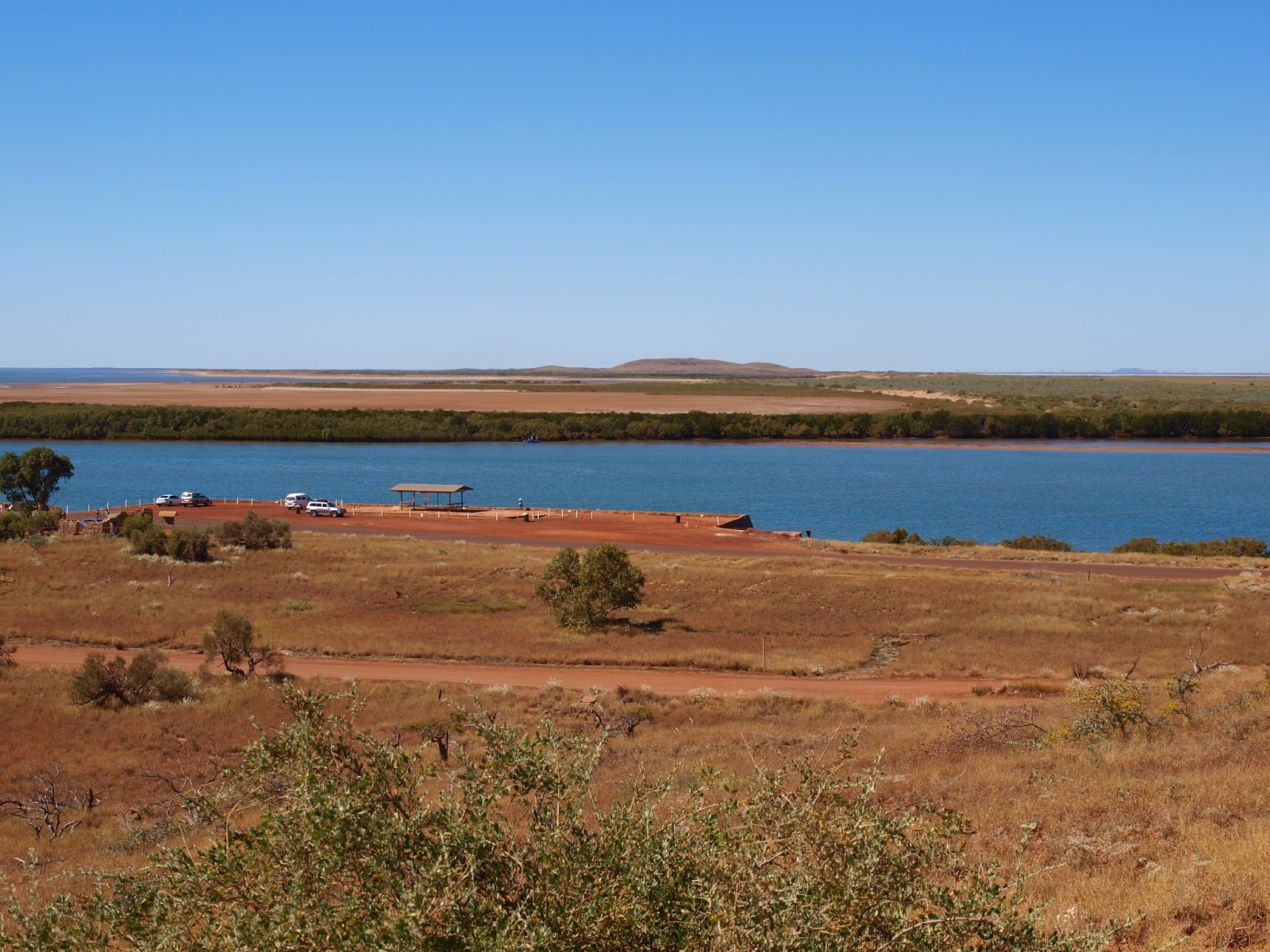
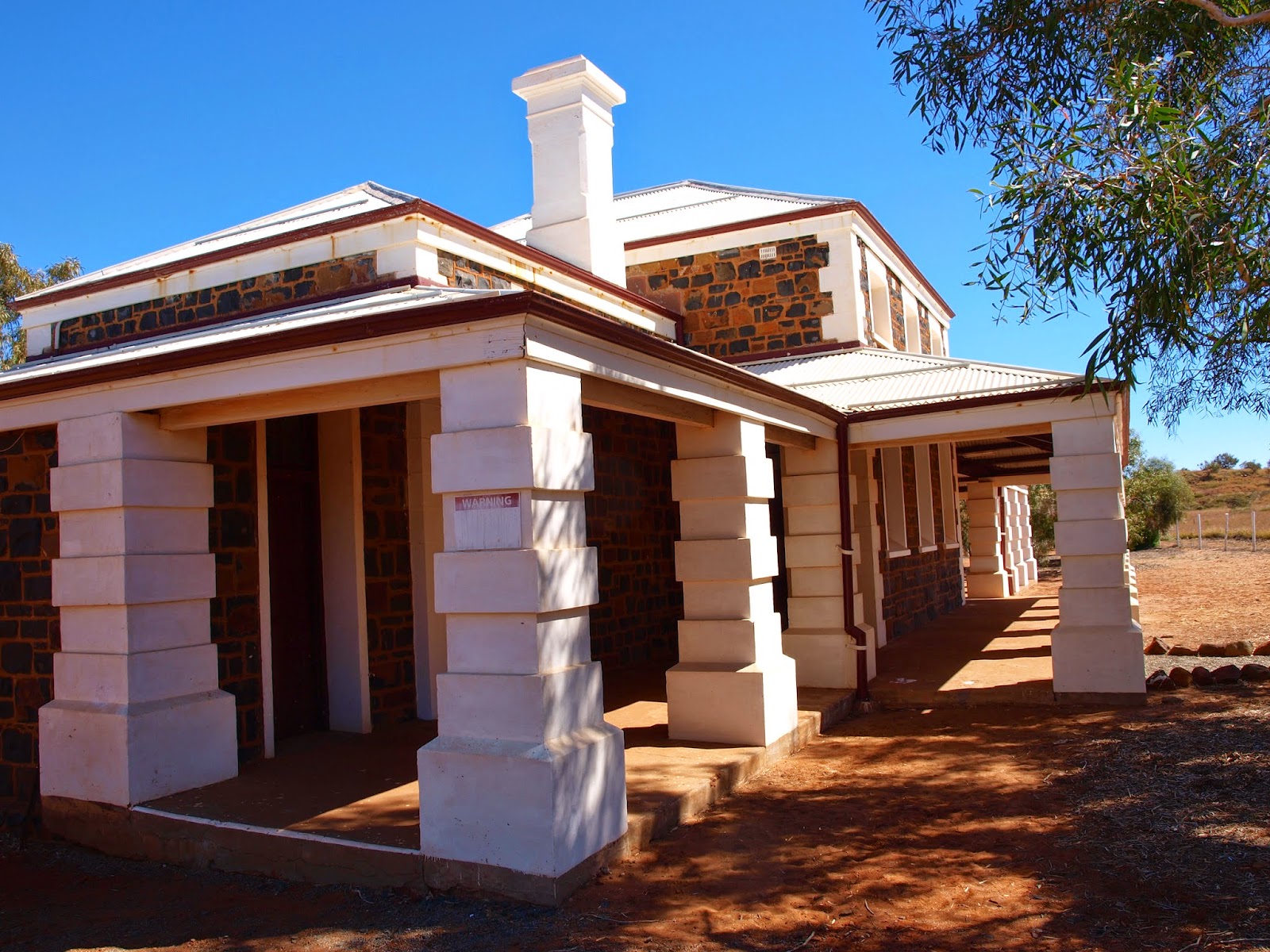
After setting up, we drove up to explore the old town site.  There is very little left, but going by the plaques spread over great distances, it was obviously of some size.  The only buildings left are the police complex and gaol.  These were quite substantial buildings and we were quite impressed wih the river stone bricks the buildings were made from.  The exercise area was unroofed and still has the embedded broken glass to deter any attempts to get over the top.


Rings are still attached to the floor

Exposed brickwork


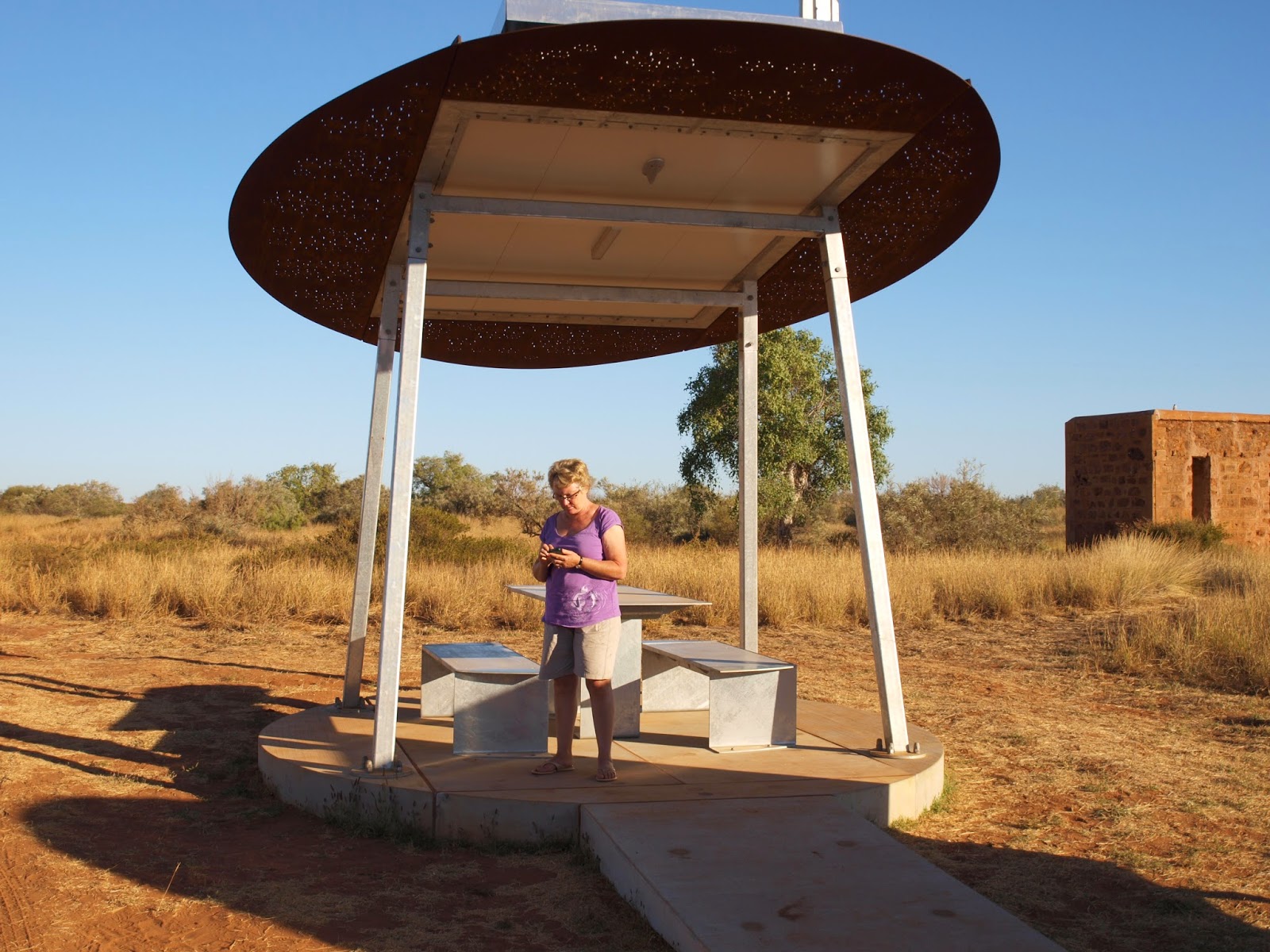
Welcome Rest Stops.  They pop up in the least expected places, such as Old Onslow.  They normally have a toilet, dump point and shelter with free wifi.  Only it often doesn't work very fast if at all.


All that is left of Old Onslow


We also drove down to the old jetty area, and it was hard to imagine there had once been a river there.
The jetty 

It was getting on dark when we got back to camp, and we enjoyed our camp fire by the river.
View from the caravan

Tuesday morning we drove the 35 k's into Exmouth.  We had opted not to stay at the overpriced caravan park.  That's what happens when the mining industry takes over.  There is a second caravan park, but that now has only permanents.  On the way past the airport we were amazed to see a sign offering contractors accommodation at $290 a night!  We thought that was bad enough until we found a notice board advertising a 2 bedroom unit at $1900 a week.  Talking later to the girl at the info centre, she was telling us how expensive everything is.  I asked about a hairdresser, and discovered they work from home as rent is too high here.  She also told us she orders her groceries from Perth (nearly 1500 kilometres) and the $80 freight still comes out cheaper than the supermarket here.  And it arrives on the same truck as the supermarket supplies.  I can understand where she is coming from when I went in and discovered broccoli at nearly $10 a kilo and bananas $7.50.


War memorial in the shape of the digger's hat band.  Designed so the sun shines through on Anzac morning
A seat at the memorial, very well done with the bronzed hats


From one of the lookouts at Exmouth


I hadn't expected to spend long in Exmouth, and hadn't taken any lunch with us.  We went to the lookout area, admiring the impressive war memorial, and took the 2 kilometre board walk.  There was also an interesting museum attached to the information centre.  We drove out to Four Mile Beach where Jim got lots of bites but no fish.  So by the time we got back to the caravan it was a late lunch, and unfortunately the horrible strong wind had returned.  We ate inside which is very unusual for us.  After a short while of being cooped up, we decided to put up with the wind and do some more exploring.  About 3 k's down the road is a causeway across the river.  Right next to it a major gas pipeline has been put in, and we could still see some of the 4 metre deep trench.  There were also new roads going everywhere, so it took a little looking to find the existing one that followed the river down the other side.  We had stopped and talked to another camping before crossing, who told us it was almost impossible to get to the river mouth, so we didn't attempt this, but found a spot on the river that looked promising.   Lots and lots of good bites but only one small fish.  I guess we will be back to give it another go.